
EUCAST Guidance

AST methods for IV Fosfomycin
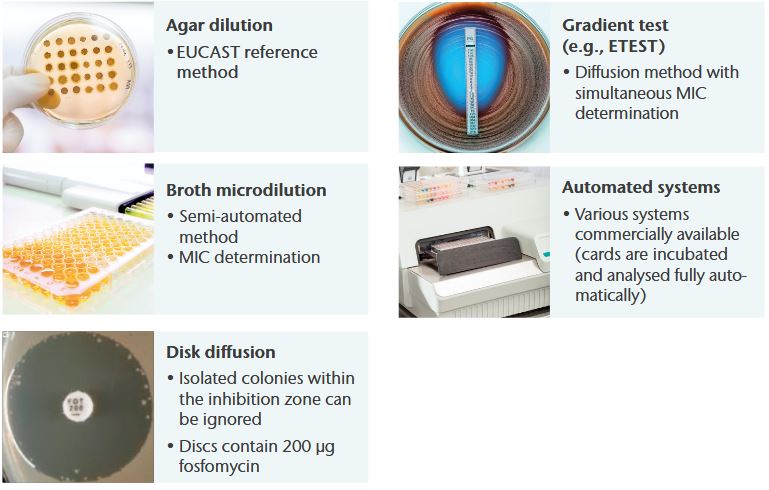
AST methods for IV Fosfomycin

General notes

  • Agar dilution is the reference method for IV fosfomycin recommended by EUCAST
  • Minimum inhibitory concentrations (MICs) must be determined in the presence of glucose-6-phosphate (G6P) (25 mg/L in the medium)
  • Recommended medium for agar dilution or other diffusion methods: Mueller-Hinton agar
  • Isolated colonies within the inhibition zone can be ignored in disk diffusion testing (only E. coli)
  • Follow manufacturer‘s instructions for commercial systems (available systems include gradient tests, automated systems, and ready-to-use agar dilution panels)

Monotherapy

EUCAST Breakpoint Tables 1
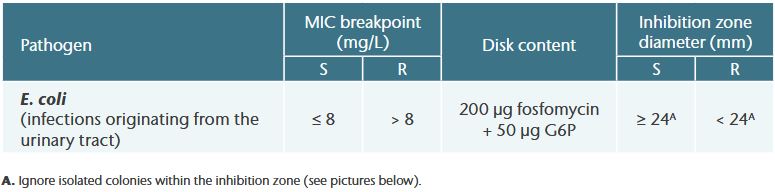
EUCAST Breakpoint Tables

Examples of interesting inhibition zones for E. coli (agar diffusion testing)
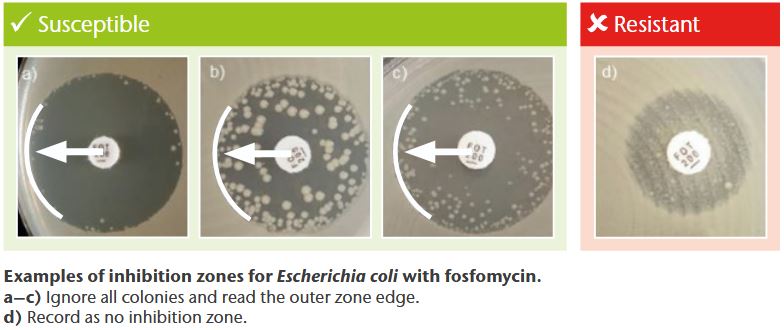
Inhibition Zones

Combination therapy

EUCAST Breakpoint Tables 1
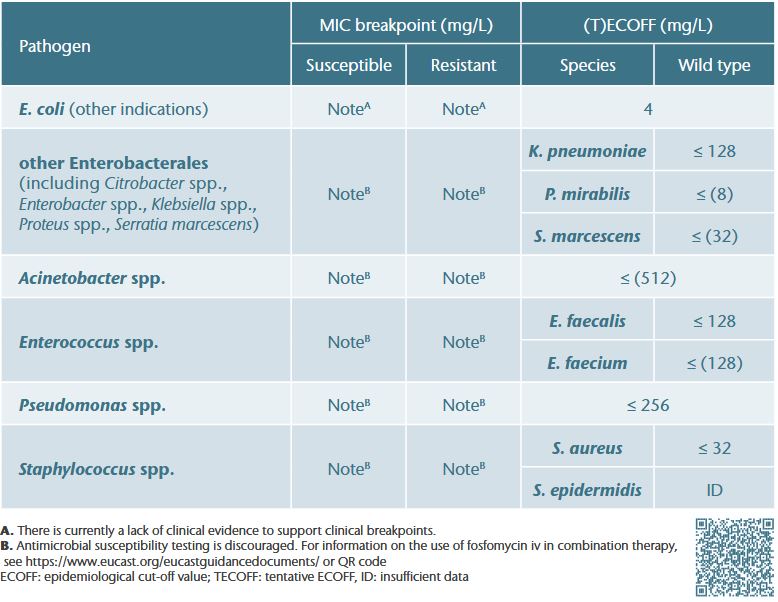
EUCAST Breakpoint Tables

Interpretation of EUCAST breakpoint tables

  • For agents used primarily in combination with other antibiotics, EUCAST does not provide clinical breakpoints but introduced the concept of breakpoints in brackets 1
  • Limited data show no evidence to suggest that the ECOFF (determined for fosfomycin alone) is predictive of clinical efficacy in combination therapy. Thus, no breakpoints in brackets have been established for IV fosfomycin 2,α
  • However, these data suggest that treatment success of IV fosfomycin in combination is possible up to or even above species-specific ECOFFs, indicating that even isolates with high MICs can still be effectively treated in combination therapyγ
  • The use of IV fosfomycin in combination therapy is therefore a primarily clinical decision #
  • Nonetheless, (T)ECOFFs can be used to monitor acquired resistance (i.e., to distinguish between wild-type isolates and isolates with acquired resistance (non-wild type))β

Rationale for the clinical use of IV Fosfomycin in combination therapy

  • Therapy-relevant, substance-specific properties including
    – high plasma3-6 and tissue levels7-13 including attainment of PK/PD targets3, 4, 14-25
    – excellent tissue penetration properties 26 (i.e., difficult-to-reach compartments/deep-seated infections)
    – biofilm 27-29 and intracellular activity30,31
    – synergy with many antibiotic classes32
    – bactericidal activity, good tolerability with a broad antimicrobial spectrum33
  • Available clinical data in the approved indications34-52
  • Recommendations in guidelines/expert opinions 53-71 (e.g., for the treatment of infective endocarditis, complicated urinary tract infections, sepsis, nosocomial pneumonia, CNS infections, bone and joints infections, soft/skin tissue infections

EUCAST guidance on when there are no breakpoints

EUCAST provides a flowchart on how to proceed for species where clinical breakpoints are lacking. The guidance document can be accessed using this link: https://www.eucast.org/fileadmin/src/media/PDFs/EUCAST_files/Guidance_documents/Use_of_fosfomycin_iv_breakpoints_General_advice_20240528.pdf

You are leaving
You are now leaving fomicyt.co.uk
This link takes you to a third party website (outside of the Fomicyt® UK website). InfectoPharm Ltd has no control over the content or management of third party websites nor can it be held responsible or liable for such content or management. Please make sure the contents therein are suitable for you as per its intended audience and the application laws and regulations. It is recommended that you carefully read the legal notice and cookies and privacy policy of third party websites before accessing these sites. If you wish to continue, click ‘CONTINUE’, or otherwise click ‘Stay on page’ -->
CONTINUE
Stay On Page

  1. EUCAST Breakpoint tables v15.0, 2025. http://www.eucast.org
  2. EUCAST guidance on use of fosfomycin i.v. breakpoints. https://www.eucast.org/fi leadmin/src/media/PDFs/EUCAST_fi les/Guidance_documents/Use_of_fosfomycin_iv_breakpoints_General_advice_20231127.pdf
  3. Busse D, et al. Antimicrob Agents Chemother. 2022;66(6):e0230221
  4. Merino-Bohórquez V, et al. Clin Microbiol Infect. 2018;24(11):1177-83
  5. Pfausler B, et al. 2004;53(5):848-52
  6. Wenzler E, et al. Antimicrob Agents Chemother. 2017 Aug 24;61(9):e00775-17
  7. Joukhadar C, et al. J Antimicrob Chemother 2003; 51: 1247–1252
  8. Matzi V, et al. J Antimicrob Chemother 2010; 65: 995–998
  9. Sauermann R, et al. Antimicrob Agents Chemother 2005; 49:4448–4454
  10. Kuhnen E, et al. Infection 1987; 15:422–424
  11. König C, et al. Ann Clin Microbiol Antimicrob 2023; 24: 22-29
  12. Schintler MV et al. J Antimicrob Chemother. 2009 Sep;64(3):574-8
  13. Hirt SW, et al. Z Kardiol. 1990 Sep;79(9):615-20
  14. Albiero J, et al. Antimicrob Agents Chemother. 2016;60(7):4128-39
  15. Al Jalali V, et al. Antimicrob Agents Chemother. 2020. 65(1): e01375-20
  16. Busse D, et al. Antimicrob Agents Chemother. 2022;66(6):e0230221
  17. Darlow CA, et al. Antimicrob Agents Chemother. 2021. 65(7): e00293-21
  18. Edwina AE, et al., Eur J Clin Pharmacol. 2023 Jun;79:775-787
  19. Kanchanasurakit S, et al. Infect Chemother. 2020. 52(4):516-529
  20. Leelawattanachai P, et al. Antibiotics (Basel). 2020;9(9)
  21. Martins FS, et al. Br J Clin Pharmacol. 2021 Mar; 87:1012-1023
  22. Ortiz Zacarías NV, et al. Pharmacol Res Perspect. 2018;6(1):e00378
  23. Rinaldi M, et al. Antimicrob Agents Chemother. 2023 May 1;65(5):e02038-20
  24. Rodríguez-Gascón A and Canut-Blasco A. Rev Esp Quimioter. 2019;32 Suppl 1(Suppl 1):19-24
  25. Wang G, et al. BMC Infect Dis. 2021;21(1):307
  26. Falagas ME, et al. Clin Microbiol Rev. 2016 Apr;29(2):321-47
  27. Mihailescu R et al. Antimicrob Agents Chemother. 2014 May;58(5):2547-53
  28. Covre S et al. Antimicrob Agents Chemother. 2013 Mar;57(3):1421-7
  29. Oliva A et al. Antimicrob Agents Chemother. 2014;58(3):1284-93
  30. Trautmann M et al Infection. 1992 Nov-Dec;20(6):350-4
  31. Valour F et al. Antimicrob Agents Chemother. 2015 Apr;59(4):2029-36
  32. Antonello RM et al. Antibiotics (Basel). 2020 Aug 10;9(8):500
  33. Fomicyt® 40 mg/ml powder for solution for infusion. Summary of Product Characteristics. October 2020
  34. Oliva A et al. JAC Antimicrob Resist. 2022 Dec 7;4(6):dlac121
  35. Oliva A, et al. Intravenous (i.v.) fosfomycin for the treatment of severe infections caused by Gram-negative pathogens: an update from a European, multi-centre, non-interventional and prospective clinical study (FORTRESS). ECCMID 2023, Copenhagen, poster presentation
  36. Grillo S et al. Nat Med. 2023 Oct;29(10):2518-2525
  37. Bodmann KF, et al. Real-world data on the use of intravenous (IV) fosfomycin for the treatment of critically ill patients: an update from a European, multicentre, non-interventional and prospective clinical study (FORTRESS). ECCMID 2024, Barcelona, poster presentation
  38. Hagel S, et al. Effectivenss and safety of intravenous (i.v.) fosfomycin for combination therapy of complicated S. aureus infections: first insights from a European, multicentre, noninterventional and prospective clinical study (FORTRESS). ECCMID 2023, Lisbon, poster presentation
  39. Karbysheva S, et al. A. Efficacy and safety of intravenous fosfomycin in patients with PJI – the PROOF study. Oral presentation. ECCMID 2021
  40. Pujol M et al. Clin Infect Dis. 2021 May 4;72(9):1517-1525
  41. Sojo-Dorado J, et al. JAMA Netw Open 2022; 5(1):e2137277
  42. Kaye KS, et al. Clin Infect Dis 2019; 9(12):2045-2056
  43. Tseng TC et al. Infect Dis Ther. 2023 Feb;12(2):589-606
  44. Putensen C, et al. Infection. 2019 Oct; 47:827-836
  45. Grabein B et al. Clin Microbiol Infect. 2017 Jun;23(6):363-372
  46. Khawcharoenporn T et al. Int J Antimicrob Agents. 2018 Dec;52(6):828-834
  47. Renz N, et al. BMC Infect Dis. 2019;19(1):1083
  48. Rieg S, et al. J Antimicrob Chemother. 2020 Aug 1;75(8):2282-90
  49. Russo A et al. Int J Antimicrob Agents. 2023 Jul;62(1):106825
  50. Russo A et al. Infect Dis Ther. 2021 Mar;10(1):187-200
  51. Tsegka KG, et al. Expert Rev Anti Infect Ther. 2021:1-11
  52. Tsegka KG, et al. Expert Review of Anti-infective Therapy. 2020:1-12
  53. Ariza J, et al. Enferm Infecc Microbiol Clin. 2017;35(3):189-95
  54. Bodmann KF, et al. S2k-Leitlinie: Kalkulierte parenterale Initialtherapie
    bakterieller Erkrankungen bei Erwachsenen – 2nd Update 2019. Associa-
    tion of the Scientific Medical Societies (Germany). Paul Ehrlich Society
    for Chemotherapy (ed). 2019; Guideline no. 082-006, 01
  55. Coppola N, et al. Antibiotics (Basel). 2022;11(9)
  56. Delgado V, et al. Eur Heart J. 2023 Oct 14;44(39):3948-4042
  57. Herrera-Hidalgo L, et al. Antibiotics (Basel). 2023;12(4)
  58. Gatti M, et al. Microorganisms. 2023;11(2)
  59. Izakovicova P, et al. EFORT Open Rev. 2019;4(7):482-94
  60. García de la Mària C, et al. Expert Rev Anti Infect Ther. 2023;21(3):281-93
  61. Nau R. Hirnabszess, S1-Leitlinie, 2021, in: German Society of Neurology (eds.), Leitlinien für Diagnostik und Therapie in der Neurologie.
    Online: www.dgn.org/leitlinien (accessed 06.11.2022). 2021
  62. Oliva A, et al. J Clin Med. 2023;12(24)
  63. Paul M, et al. Clin Microbiol Infect. 2022;28(4):521-47
  64. Pfister HW, et al. S2k guidlines on community-acquired bacterial meningoenzephalitis in adults. German Society of Neurology. 2023
  65. Sartelli M, et al. Antibiotics (Basel). 2022;11(10)
  66. Tiseo G, et al. Int J Antimicrob Agents. 2022;60(2):106611
  67. van de Beek D, et al. Clin Microbiol Infect. 2016;22 Suppl 3:S37-62
  68. Volpicelli L, et al. Antibiotics (Basel). 2021;10(12)
  69. Rademacher J, et al. Update der S3-Leitlinie: Epidemiologie, Diagnostik und Therapie erwachsener Patienten mit nosokomiale Pneumonie. 2024. https://register.awmf.org/de/leitlinien/detail/020-013
  70. Pintado V, et al. Enferm Infecc Microbiol Clin (Engl Ed). 2023 Jun-Jul;41(6):360-370.
  71. Meschiari M, et al. Int J Antimicrob Agents. 2024 Jul;64(1):107186.
  72. Position Paper of the Working Group on EUCAST recommendations (https://korld.nil.gov.pl/wp-content/uploads/2024/05/Stanowisko-Zespolu-7-2024.pdf)
  73. CA-SFM (https://www.sfm-microbiologie.org/wp-content/uploads/2024/06/CASFM2024_V1.0.pdf)
  74. Oliva A, et al. Effect of fosfomycin minimal inhibitory concentration determined by agar dilution on outcomes of ceftazidime/avibactam plus fosfomycin combination for the treatment of KPC-producing K. pneumoniae bloodstream infections. ECCMID 2024, poster presentation
  75. Ning Y, et al. Clinical experience with intravenous (IV) fosfomycin for treatment of complex bone and implant-associated infections: prospective cohort. ECCMID 2024, Barcelona, poster presentation
  76. Kahlmeter G and Turnidge J, Clin Microbiol Rev. 2023 Dec;36:e0010022
  77. Mouton JW, et al. J Antimicrob Chemother 2018 Mar; 73:564-568
  78. German NAC (https://www.nak-deutschland.org/nak-deutschland/faq.html))